
Gallery
Alfréd Justitz (1879–1934)
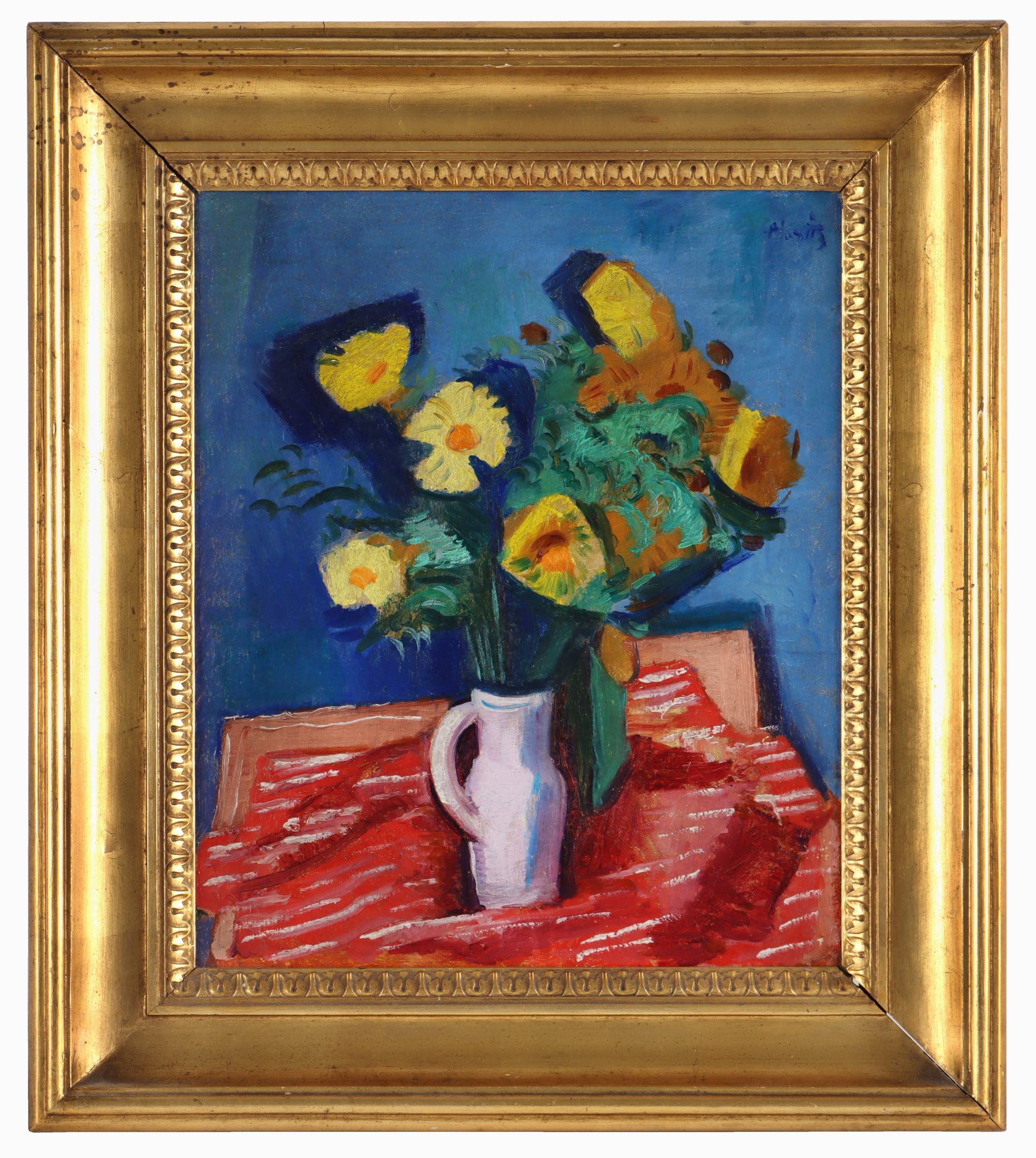
Flower Bouquet, 1920s, oil on canvas, signed upper right A. Justitz; on the reverse with the artist’s inscription A. Justitz, Praha II., Spálená 55 and auction labels, painting dimensions 55 × 46 cm, overall dimensions with frame 76 × 66 cm.
Exhibited: REDISCOVERED MASTERPIECES from Private Collections, 21–30 November 2019, exhibition premises of Galerie Zlatá husa, Dlouhá 12, Prague 1; the work reproduced in the catalogue on pages 26 and 27.
Expert Opinion: PhDr. Rea Michalová, Ph.D.
From the report: The assessed painting “ Flower Bouquet ” is an authentic, very high-quality, and painterly generous work by Alfred Justitz, a significant member of the founding generation of Czech modern art, whose artistic production reflected his personal nobility. His work grew out of a deep knowledge of tradition, building upon the legacy of Czech and European painting from the Baroque through Romanticism and Post-Impressionism, while also engaging with contemporary movements such as Cubism and (Neo)Classicism. From the outset, Justitz was a solitary figure; in his youth he did not join Osma nor the members of the later Group of Fine Artists. In the early 1920s, however, he came into contact with the Tvrdošíjní (The Stubborn Ones) – their effort to create an original domestic expression grounded in European art resonated strongly with him. He exhibited with them as a guest in 1921 and 1923. The friendships he formed at that time with Václav Špála and others endured in the years that followed.
The assessed work, with its superb artistic and compositional treatment of the floral still-life theme, can be described as a celebration of the sensual values of painterly culture – the visual form is carried here to maximum freedom while maintaining precise compositional structure derived from late Cubism. The late 1920s brought a rejuvenation of the artist’s work. He rediscovered Cubism, transforming it in his own distinctive manner. In terms of professional terminology, the painting ranks among the striking examples of so-called “pure visuality” (V. Kramář), a tendency that gained prominence in Czech art from the second half of the 1920s onward. It emphasized the visual conception of the image, the dominance of painterliness over objecthood, without relinquishing the reality upon which this visuality was based. The bouquet of freshly picked flowers represented for the artist an “extract” of sensory beauty. The painting stands as excellent evidence of the postwar turn toward natural aesthetics, which manifested itself in other ways as well – for example, in the urban individual’s retreat into the countryside, the rise of tramping, the more frequent construction of family house colonies with gardens (in Prague, Ořechovka, Hanspaulka, etc.), or in fashion, in the ideal of the bronze-tanned woman à la Coco Chanel. This trend was aptly described in the early 1930s by Václav Špála: “Today there is generally a greater interest in flowers, in gardens, which of course also finds an echo in paintings, for painters directly participate in fostering this interest.”
“Flower Bouquet” is a beautiful work by Justitz, created with sovereign painterliness, the ability to disregard the nonessential and to realize a compact whole through which the viewer penetrates from the reality of the image to the reality of life. This painting is a superb testament to the artist’s still insufficiently recognized intoxication with contrasts and harmonies of color and form.
Other products
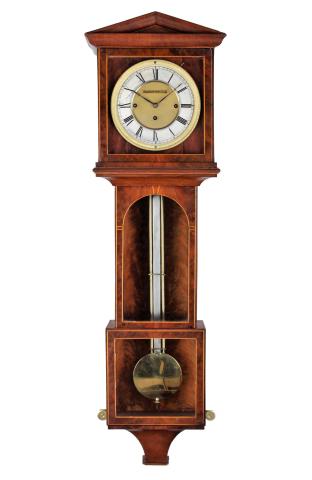
Miniature wall clock - Laterndluhr
Wall-mounted pendulum clock, so-called lantern clock, circa 1830, Vienna; dial signed I. Vlaschitz in Wn. Neustadt (Ignatz Vlaschitz in Wien Neustadt).
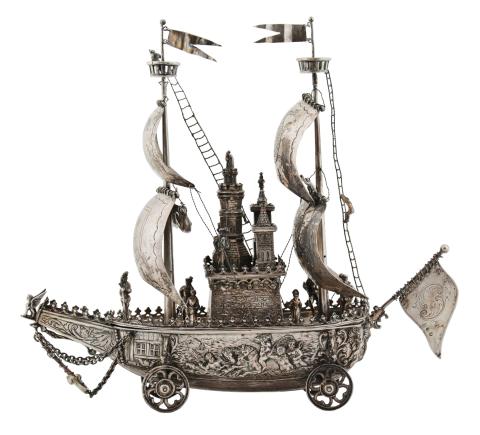
Silver model of a ship with figural decoration
Germany, Hanau, 19th century. Two-part silver model of a ship with rich figural and sculptural decoration, comprising a total of 12 figures.
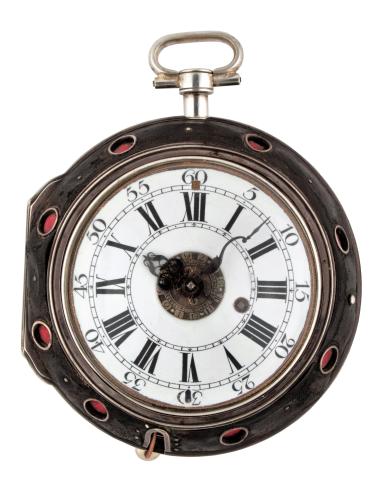
Large Baroque carriage clock – Joseph Spiegel
Germany, Friedberg, Joseph Spiegel (Joseph Miroir), circa 1740. Large double-cased traveling striking clock with date display and alarm.
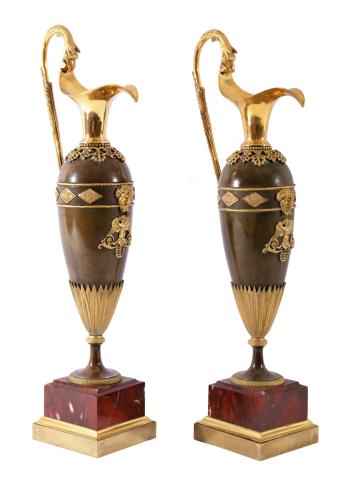
Pair of Empire teapots – Claude Galle
France, Paris, circa 1810. A luxurious pair of bronze ewers produced in the renowned workshop of Claude Galle (1759–1815).