
Gallery
Antonín Slavíček (1870 – 1910)
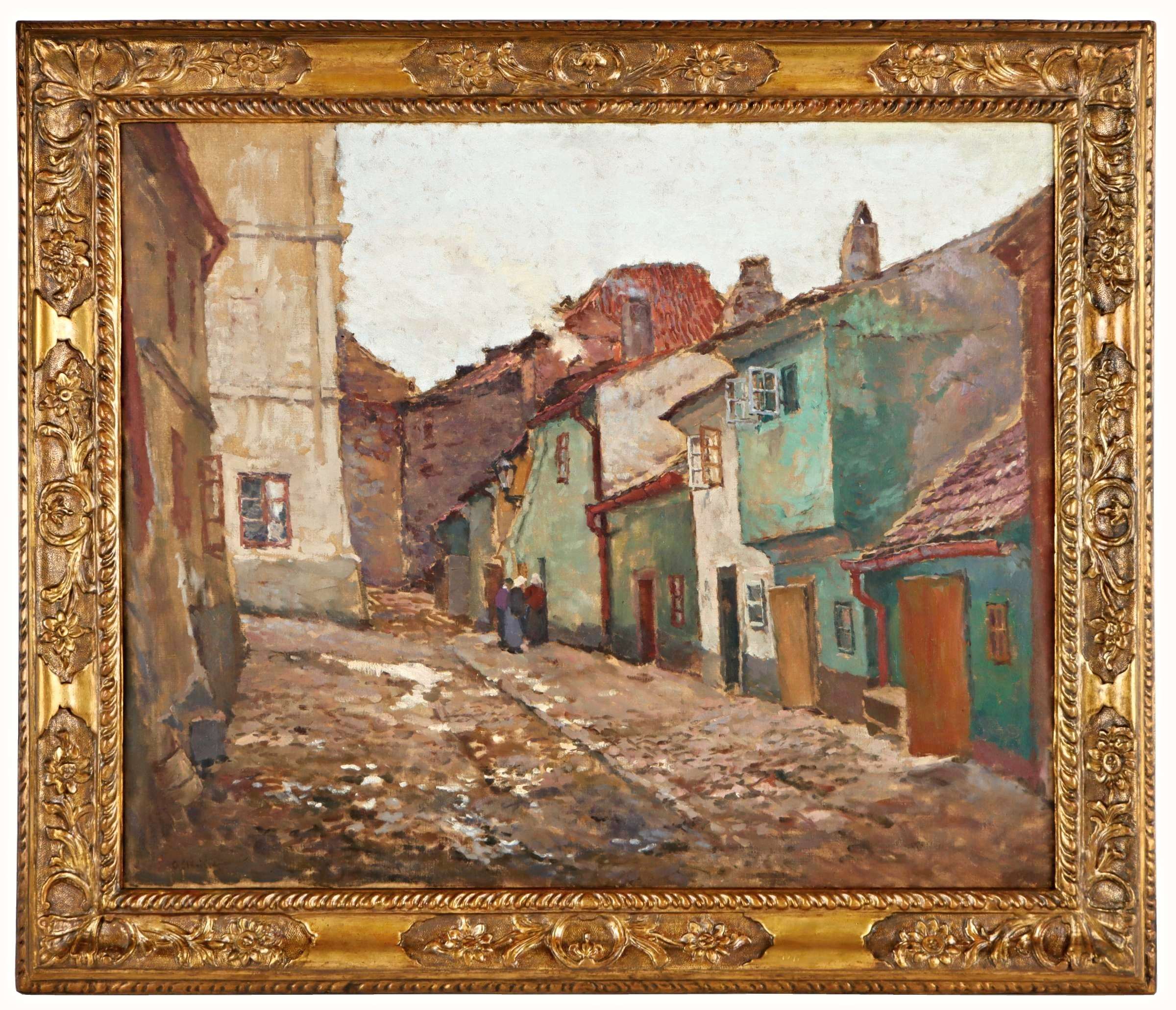
Golden Lane, 1906, oil on canvas, signed lower left A. Slavíček; painting dimensions 74 × 92.5 cm. On the reverse: inscriptions, five exhibition labels, two labels of the National Gallery in Prague with inventory number O 2007, and a label of the Waldes Gallery with number 982. Period-style framing; overall dimensions including the frame: 94 × 110 cm.
This iconic work by the most celebrated Czech landscape painter and Impressionist, Antonín Slavíček, ranks among his most renowned paintings. In terms of exhibition and publication history, it is also the most significant oil painting by Slavíček to have appeared on the art auction market over the past several decades.
Antonín Slavíček painted Golden Lane in the second half of September 1906 and described it in a letter to Ladislav Janík, detailing his emotions, colors, and the people connected with the work. This letter may be regarded as an almost literary counterpart to the painting itself.
Provenance:
The first owner of the painting was most likely the well-known interwar art dealer Salvator Kominík, as confirmed by a contemporary inscription on the reverse of the canvas. The work was subsequently acquired by the prominent Czech entrepreneur of Jewish origin, patriot, art collector, and patron Jindřich Waldes (1876–1941).
In 1939, the painting was confiscated by the Gestapo and for many years deposited in the collections of the National Gallery in Prague under inventory number O 2007. After 1996, the work was restituted to the heirs of industrialist Jindřich Waldes and, from the late 1990s to the present, has formed part of an important private collection.
Exhibitions (selected):
Exhibited numerous times, including internationally, for example:
1911 – Hagenbund, SVU Mánes, Vienna, Räume des Künstlerbundes Hagen, Zedlitzgasse, cat. no. 23
1927 – Czechoslovak Art Exhibition in Warsaw; owner: Jindřich Waldes; insured value: CZK 40,000
1932 – SVU Mánes, cat. no. 126 (dated here to 1907)
1946 – Poš Gallery, Prague, cat. no. 3
1947 – National Gallery, SMU, cat. no. 403
1954 – Exhibition of Czechoslovak Art, Moscow, Warsaw, Budapest, cat. no. 193
1955–1956 – Exhibition of Czechoslovak Art, Nanjing, Shanghai, Beijing, cat. no. 28
1957 – National Gallery, SMU, cat. no. 272
1959 – National Gallery, SMU, cat. no. 273
1961 – National Gallery in Prague, Exhibition of Antonín Slavíček, Riding School of Prague Castle, cat. no. 199
1975 – National Gallery in Prague, Ljubljana, cat. no. 103
Literature (selected; repeatedly reproduced):
Volné směry, Vol. XIV, Miloš Jiránek, SVU Mánes, 1910, p. 184 (dated here to 1907)
František Kovárna: Antonín Slavíček, SVU Mánes, Prague 1930 (dated here to 1907)
Václav Vilém Štech: From the Gallery of Prague Castle, Jan Štenc, Prague 1933, no. 23 (Golden Lane at Hradčany)
Zdeněk Wirth: Prague in Paintings of Five Centuries, Jan Štenc, Prague 1934, no. 246
Vítězslav Nezval: Antonín Slavíček, Orbis, Prague 1952 (foreign editions 1955), reproduction no. 55
Vítězslav Nezval: Antonín Slavíček – Letters, State Publishing House of Fine Literature, Music and Art, Prague 1954, color reproduction, p. 97, repro. no. III
Václav Vilém Štech: Readings on Antonín Slavíček, State Publishing House of Fine Literature and Art, Prague 1961, color reproduction, p. 97, repro. no. 10
National Gallery: Antonín Slavíček 1870–1910, Riding School of Prague Castle, 1961, p. 107, repro. no. 199
J. Kotalík, M. Hovorková, L. Karlíková: Antonín Slavíček 1870–1910, Catalogue Raisonné, SNKLU, Prague 1965, p. 215, repro. no. 215
Jan Tomeš: Antonín Slavíček, Odeon, Prague 1966, color reproduction p. 65, fig. no. 19; later reproduced in black and white and listed in the catalogue raisonné under no. 274
Orbis, series of color postcards of works by Antonín Slavíček
ODEON Publishing House, color reproduction as a postcard
Expert report: PhDr. Rea Michalová, Ph.D.
From the expert report:
The presented painting Golden Lane is indisputably an authentic work of gallery quality, of exceptional collector’s value, and a painterly and thematic masterpiece by Antonín Slavíček—one of the greatest “stars” of the so-called Generation of the 1890s, which faced the demanding task of “catching up with Europe.” In his work, Slavíček followed his genius artistic instinct and developed a highly individual style inspired by Impressionism, whose aesthetics he never fully embraced. Faithful to Czech artistic tradition, he sought to transcend mere visual delight. His premature death represented a tragic loss for Czech art at the dawn of the twentieth century.
The painting Golden Lane is a pinnacle work—collector’s rare and virtually unparalleled on the market in terms of quality—by Antonín Slavíček, the most important Czech modern landscape painter. Prague themes appeared in his work already during his early, happy years, but especially after his landscape period, he came to identify with the city of his birth in a new way. As Jana Orlíková wrote, Slavíček was a great walker who traversed Prague extensively, from the city center—from St. Agnes Convent through the Old Town and Hradčany to Letná—as well as its outskirts (Kobylisy, Troja), which also became his subjects. One could say that he artistically absorbed the entire beloved city and matured from small formats to large, fully resolved compositions such as the present work, which ranks among the unquestionable peaks of his lifelong oeuvre. The painting is masterfully executed with an impressionistic texture of small color patches, whose vibrant application allowed Slavíček to express perfectly both what he saw and what he felt about what he saw.
The very subject of Golden Lane deserves special attention. It is a space within the Prague Castle complex, situated between Daliborka Tower and St. George’s Convent. The northern wall of this blind alley is formed by houses of varying age, size, and shape, though the plots themselves are uniform. The houses were built during the 17th century; according to a decree of Rudolf II from 1597, they were intended for castle marksmen. During the reign of Joseph II, the corps was dissolved, and the lane acquired a civilian character. The southern Romanesque wall likely featured houses built at the same time (or even earlier), inhabited from the outset by civilians—servants, hospital workers, attendants, and above all small craftsmen, most likely goldsmiths, who gave the lane its name. Spatial congestion and poor hygiene led to sanitation measures in the 19th century.
Golden Lane has always attracted artists; Franz Kafka lived for a time in house no. 22. The Polish poet Stanisław Przybyszewski expressed his wish to live there and write a novel about Prague. The lane is also shrouded in legends of alchemists from the time of Rudolf II. An unsubstantiated legend claims that alchemists employed by Rudolf II lived and worked here, seeking the secret of producing gold to fill the royal treasury.
Among all of Prague Castle, the “alchemists’ lane” fascinated Slavíček the most. In his letters, he mentioned its inhabitants, who shaped his overall impression of the place. In 1906 he wrote:
“I already know the people who live there in the green, white, and brown little houses, stuck together and irregular—simply as needed and as comfort then required. I would move there immediately! And I take such joy in that corner. As if the great city were only a few hours away from me.”
These written impressions are perfectly mirrored in the present work. Antonín Slavíček captured a unique moment when sunlight falls into the narrow Golden Lane, intensifying the colors of the picturesque houses. Golden Lane is a painting deeply experienced by Slavíček both emotionally and artistically. His impressionistic hand here reaches perfection—as if every brushstroke signified life. The painter worked thoughtfully yet swiftly, so that the substance of the painting seemed to emerge before him, freeing his hand from conventional representation.
The presented painting Golden Lane is the deepest expression of Antonín Slavíček’s artistic and personal credo.