
Gallery
Karl Gottfried Traugott FABER (1786-1863)
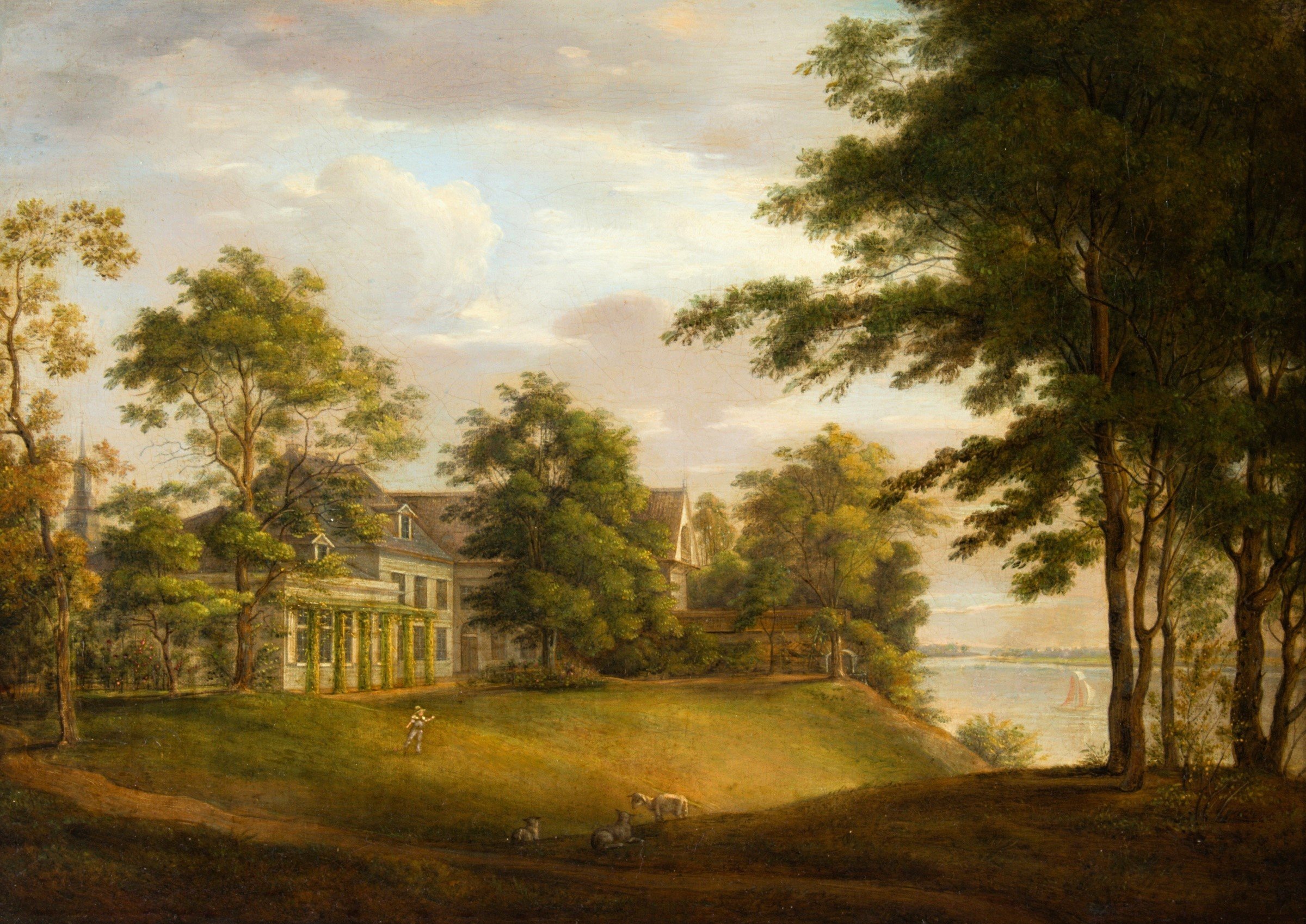
Title: View of a Manor House by the River Elbe
Date: 1820s–1830s
Technique: Oil on canvas
Signed: Lower right “T. Faber”
Painting dimensions: 28 × 39 cm
Overall dimensions with frame: 35.5 × 47 cm
Provenance: Important aristocratic collection
Karl Gottfried Traugott Faber was an outstanding Dresden landscape painter, a respected printmaker, and a watercolorist. He took drawing lessons with Georg Friedrich Fechhelm and later studied for more than ten years in the studio of Johann Christian Klengel. He studied the works of Dutch landscape painters and transferred their methods into his own paintings. He painted views of Dresden, Saxon Switzerland, the spa town of Teplice, Biedermeier bourgeois idyllic scenes, and romantic mood landscapes such as Morning in Saxon Switzerland.
Together with other artists, he was selected to create paintings and more than five hundred watercolor vedute of Saxon towns for the regent and later King Friedrich August II, intended for a gallery honoring the landscape of the Kingdom of Saxony—the “Galerie vaterländischer Landschaften.” In 1820 he became a member of the Dresden Academy of Fine Arts, where he had exhibited since 1801 and from which he withdrew in 1850. Between 1815 and 1834 he taught drawing at the Dresden Freemasons’ Institute (Dresdner Freimaurerinstitut). Among his students were Ferdinand von Rayski, Carl Wagner, and Carl Friedrich Häbler.