
Gallery
Maxim Kopf (1892 – 1958)
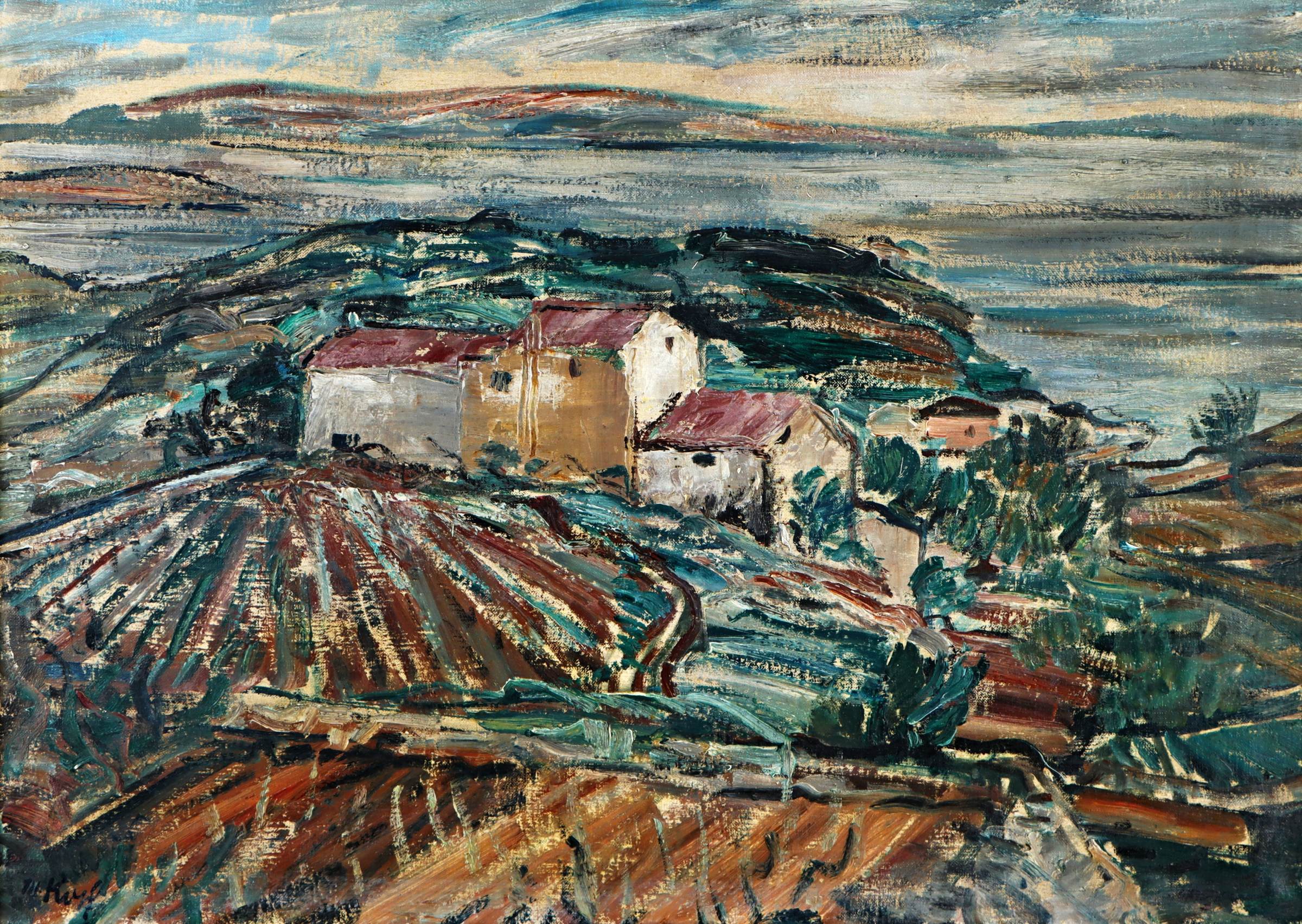
Seascape (From Dalmatia), most likely around 1934, oil on canvas, signed lower left M. Kopf, painting dimensions 55.5 × 77.5 cm, overall dimensions with frame 77.5 × 99.5 cm.
Expert opinion: PhDr. Rea Michalová, Ph.D.
From the expert report:
The submitted painting “Seascape (From Dalmatia)” is an authentic, high-quality work by Maxim Kopf, a key figure of Czech-German visual culture of the interwar period. Painterly refined and gently expressive, the work masterfully captures the character of southern scenery. A cosmopolitan of German-Austrian descent who spoke seven languages and traveled to nearly every corner of the world, Kopf was a driving force of the young postwar generation of Prague Germans, who formed a significant artistic community only recently rediscovered. Actively engaged in social life, Kopf ranked among successful and respected artists. During his lifetime he held four solo exhibitions in Prague and participated in numerous group exhibitions, particularly within the artists’ associations Die Pilger, Junge Kunst, and Prager Sezession, all of which he helped to found.
The assessed work “Seascape” is entirely characteristic of Kopf’s expressive style and testifies to his masterful ability to render an urban-landscape motif. It exemplifies the painter’s mature style, oscillating between restraint and more pronounced expression. At this time, Kopf seamlessly continued his landscapes from his Paris period in Montrouge, gradually emphasizing impasto color application and the effect of linear elements.
In the present painting, without any creative hesitation, he captured a southern hilly landscape enlivened by simple, locally typical architecture and crowned by a majestic view of a sea bay. The painterly execution—through impasto, loose, and expressively accented brushstrokes in muted tones—brilliantly conveys the illusion of a light haze in the warm southern light.
The artistic style of “Seascape (From Dalmatia)” by Maxim Kopf is best characterized by the term “expressive objectivity,” precisely reflecting the sensibility of a painter who delighted in observing the world around him and translated the joy of his vision onto the canvas.